Blog
The hallway conversation is the one we will never hear
The coverage holes in a booth-fixed capture station, written down by the people designing it rather than found later by the people buying it.
Two of the best conversations from your last show did not happen at your booth. One happened in the aisle on the way back from a keynote, with someone who never reached your counter. The other happened at a reception on the third evening, holding a drink, with the person who signs.
A station fixed to your booth counter hears neither of them. That is not a gap closing in a later revision. It is the shape of the decision, and you should read it here rather than find it in month two.
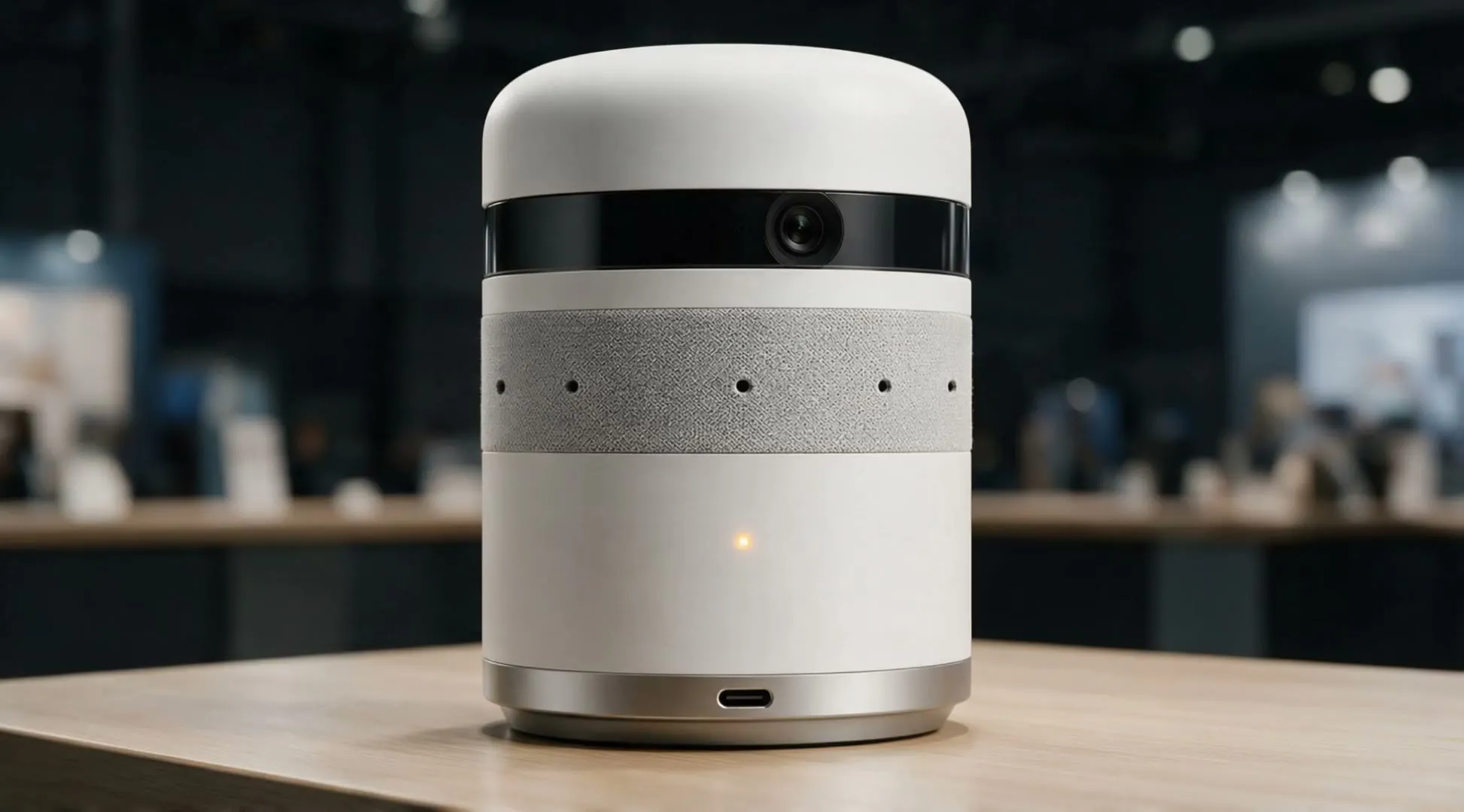
Booth-fixed capture is a category of trade-show recording in which the microphone array and the cameras stay with the furniture instead of going onto a person: one unit on the consultation counter, one cable to booth power, nothing to clip on, pair, charge or press. The rule that produces that form is zero behaviour change for the staffer, and it is a rule we bind ourselves to rather than a slogan. Coverage then becomes a geometric fact rather than a feature list. A fixed array can hear only what its position allows, which is the seats around the counter it points at. Anything a visitor says in an aisle, at another company’s stand, or at an evening reception sits outside that geometry permanently, by construction. That boundary is not a limitation to engineer away in a second revision. It is what the category is.
Where booth-fixed capture works, and where it stops
Coverage follows layout. A booth-fixed station is designed for a booth with a consultation position: a counter or a table where visitors stop, sit, and talk for more than a minute. Where that position exists, the geometry is solvable. Where it does not exist, or where the conversation walks away, the geometry is not solvable at any price.
The honest version of the coverage map is a table, and most of it is negative space.
| Where the conversation happens | Does a booth-fixed station cover it | Why |
|---|---|---|
| Counter or consultation table, island or inline booth from about 3m x 3m | Yes | The array has one fixed aim and the visitor sits inside its usable arc for the length of the conversation |
| Two tables at the same counter, roughly a metre apart | Yes, and this is the case the design exists for | Direction is the separating signal, and the tables hold still |
| Standing booth with no consultation furniture | Unresolved | There is no fixed conversation position to aim at, so placement is a judgement call per booth rather than a specification |
| Small shell scheme under about 2m of frontage | Unresolved | The unit competes for counter space with the goods, and the visitor distance changes with every conversation |
| Aisle, hallway, the walk to a session | No | Outside the booth, outside the geometry, and outside any claim we will make |
| A meeting room behind the booth | Only with a second unit installed in that room, which is the same install trade a second time | |
| Evening reception, sponsor dinner, hotel bar | No | No fixed furniture, no booth power, and consent conditions that a booth’s signage does not reach |
Three of those seven rows are a flat no and two are unresolved. We are not going to present that as a roadmap. Two of the noes follow from physics and one follows from a rule we chose, and the difference between those two kinds of no is the subject of the rest of this post.
The hallway problem
The show floor is not the booth. Visitors form opinions in aisles, at coffee queues, in the ten minutes after a keynote, and in conversations with your staff that happen entirely on foot. A device bolted to your counter has no coverage there. It never will, and there is no version of the product where it does.
We are not going to attach a percentage to how much of a show’s pipeline originates outside the booth, because no sourced figure for that exists and inventing one would be the easiest paragraph in this post to write. What is sourced is who is on the floor and when. Jonas Event Technology’s analysis of more than 130,000 registrations found that people who register twelve or more weeks out attend at 18%, while people who register in the final week attend at over 50%; C-suite registrants book around nine weeks ahead, and managers and directors six weeks or less (Hire Space, reporting Jonas Event Technology). Read that as a floor-planning fact. The senior person committed early and arrives with a schedule; the operational buyer decided late and arrives with an afternoon. Both of them walk aisles.
At the same event, Sarah Cox, MD of Jonas Event Technology, told Event Tech Live 2025 that 79% of leads gathered at events never receive a follow-up. That number is about what happens after the show, not about where the conversation started, and it is the same failure as the empty note field on a scanned badge: the record of what was said does not survive the trip home. A counter-fixed station addresses that failure for the conversations at the counter. It leaves the aisle exactly as it was.
Standing booths and small booths
Layout dependence is the second stated weakness, and it is a placement problem rather than an acoustics problem. A station needs a consultation position to aim at. A standing booth with no table, or a shell scheme under two metres of frontage, may not have one, and there the placement is genuinely unresolved.
The reason is the same geometry that makes the good case work. A fixed array separates conversations by direction, so separating two conversations at one counter depends on those conversations staying in different directions for long enough to be separated. In a standing booth people rotate, step back to let someone past, and re-form the group two metres to the left. The directions stop being stable, and direction was the whole separating signal.
Distance compounds it. Optical resolution falls off with range as a matter of arithmetic, not tuning: at 1080p across a 120-degree field, the face-pixel budget that identity work requires is exhausted at roughly 1.5 metres, which is why the distance limit reads as a privacy property rather than a shortfall. In a booth with a table, 1.5 metres is the width of the table and the constraint is free. In a standing booth, the person you are talking to is at 1.5 metres when they lean in and at three metres when they do not, and no setting changes that. It is a consequence of the optics, not a score on a test we ran.
Two-metre shell schemes add a mundane version of the same problem. The counter in a small booth is already carrying the product, the literature and somebody’s coffee. A unit that needs a clear position and a sightline is competing for the scarcest surface in the booth.
The reception floor
Evening networking is outside the coverage entirely, and this one is not close. Receptions have no fixed furniture, no booth power, no owned space, and no way to put a notice where every person in the conversation can see it before they speak. The device would have nowhere to sit and nothing to stand behind.
The consent geometry breaks before the acoustics do. Under California Penal Code section 632(a), recording a confidential communication without the consent of all parties is an offence carrying a fine of up to $2,500 per violation, and subsection (c) excludes from “confidential communication” any circumstance where the parties may reasonably expect to be overheard (California Legislative Information, as amended Stats. 2016, Ch. 855). A booth is a space you rent, sign and control, which is what makes a posted notice and a visible indicator meaningful there. A hotel bar is none of those things, and whether a conversation in one is confidential is arguable in both directions.
Signage is the other half. The Irish Data Protection Commission, writing about images at events, notes that consent “may not be practically implementable in cases of large public events” and advises signage stating the intent, the purpose and the intended use; for small gatherings its own worked example is green lanyards for consenting attendees (Irish Data Protection Commission). A booth can carry that signage. A reception cannot be made to, at least not by a vendor selling a counter unit. If you want the shape of that problem in more detail, recording consent changes by jurisdiction in ways that a single device policy cannot flatten.
What to use where we have no coverage
Where a booth-fixed station has no coverage, something else has to carry the conversation, and in most cases it is a person. We are naming categories here rather than products, because we have not run a comparison we could defend and this post is not the place to pretend otherwise.
For aisle conversations and walking meetings, the honest tools are the ones exhibitors already use: a badge scanner for the identity, and a staffer who writes one sentence within the hour. The sentence is the part that fails, which is why the note field problem is worth its own piece, and the fix there is scheduling and staffing rather than hardware.
For evening receptions, the practical answer is a small number of people briefed on who they need to find, plus a debrief the next morning before the third day starts. For meeting rooms behind the booth, the answer is a room-based capture category with its own consent notice at the door, which is a different purchase from a counter unit. For standing booths, the answer may be a table. That is a serious suggestion: if the booth design has no place for a conversation to settle, the capture question is downstream of a booth design question.
Before buying anything in any of these categories, including ours, the questions worth asking a capture vendor are the ones about mechanism rather than accuracy claims. Where is the audio processed, what does the indicator do, and who can turn it off.
What we are not going to do about it
The fix for every coverage hole in this post is the same object, and it is the object our rule forbids. Put the microphone on the person and the aisle, the reception and the standing booth all come back. That is a wearable, and a wearable asks the staffer to clip it on and charge it nightly.
Keeping the rule costs us this coverage, and we are keeping it. Once a wearable component exists, the reason to choose a fixed station over a wearable is gone, because the fixed station’s whole argument was that nobody has to do anything. A product that covers everything by asking your staff for four seconds and a nightly charge is a different product with a different failure mode, and that failure mode is the one exhibitors already live with.
The same rule produces the indicator. A recording light with no off switch is only defensible on an object that sits still in a space you control. Carry the same object into a bar and the notice stops working, which is a second reason the reception floor is not a coverage gap to be closed but a boundary to be stated.
Why a vendor should publish this
A coverage map with three flat noes in it is a strange thing for a vendor to write, and the reason is narrow. Every limit here appears in our own design notes as a weakness. Anyone deploying the product finds them on the second morning of a three-day show anyway.
There is also a category argument. Booth-fixed capture is a new enough shape that nobody has defined its edges, and defining a category by its holes is more durable than defining it by its strengths, because the holes do not move when the firmware updates. A buyer who reads this and concludes the geometry does not fit their booth has been served correctly. That outcome is not a lost sale so much as a support ticket that never happened.
None of this makes the device better than it is. It stays a candidate design with an unbuilt prototype, a set of rules it obeys, and a coverage map with more no in it than yes.
What it is for is one thing, stated narrowly. The conversation that happens at your counter, at a table, with someone who sat down: that one should still exist on Tuesday, in the right visitor’s name, without anyone having pressed anything. The aisle is not ours. The reception is not ours. The counter is.