Blog
The best device is the one you never wear
Why Scailout Station is fixed to the counter instead of clipped to your staff, and what that choice rules out.
Every capture device sold to a trade-show team so far has asked the same thing of the person wearing it: change what you do. Clip this on. Charge it nightly. Remember to press it before the conversation starts, and remember to stop it after.
That request looks small on a spec sheet. On a show floor it is the whole product.
A trade show lead capture device is any hardware an exhibitor brings to a stand to record who came and what was said: badge scanners, phone apps, wearable recorders, and the fixed units that sit with the furniture. All of them make the same architectural decision, and the decision is not about microphones. It is about who performs the capture. A badge scanner asks a staffer to aim and press. A wearable asks the same staffer to clip, charge, start and stop. Scailout Station asks for nothing, because the capture lives in the counter rather than on the person. That one choice sets the failure mode for the whole category. A device that needs an action fails when the action is skipped, and in the third hour of the third day the action is skipped. A device that needs nothing fails differently, and the rest of this post is about what we gave up to move into the second group.
The cost of the button
The button costs attention, and attention is the only thing a booth conversation runs on. A visitor gives your staffer a few seconds to be present before deciding whether this stand is worth their afternoon. Any hardware that spends part of those seconds on itself is competing with the conversation it was bought to preserve.
A booth conversation has a shape. Someone stops walking, looks up, and asks a question. Your staffer has about four seconds to be present before the visitor decides whether this booth is worth their afternoon.
Watch what fills those four seconds when a device is involved. The staffer registers that a real conversation is starting, breaks eye contact to find the control, confirms a light or a screen state, then returns. Nothing in that sequence takes long. All of it lands in the window where the visitor is still deciding whether to stay, and a visitor who has already turned back toward the aisle does not come back because the recording started cleanly.
A button steals those four seconds. So does reaching for a phone, and so does the small break in eye contact that a note-taking device produces. The recording succeeds and the conversation degrades — which is the wrong trade, because the conversation was the asset. The recording was only ever a way to keep it.
Worse, the button fails silently. A staffer mid-pitch on the third hour of a three-day show forgets. Nobody notices until the follow-up list is short and nobody can explain why. There is no error message for a conversation that was never captured, which is why the loss is discovered weeks later, in a CRM, by someone who was not standing there. The note field on a badge scanner fails the same way, for the same reason, and it has been failing that way for as long as badge scanners have existed.
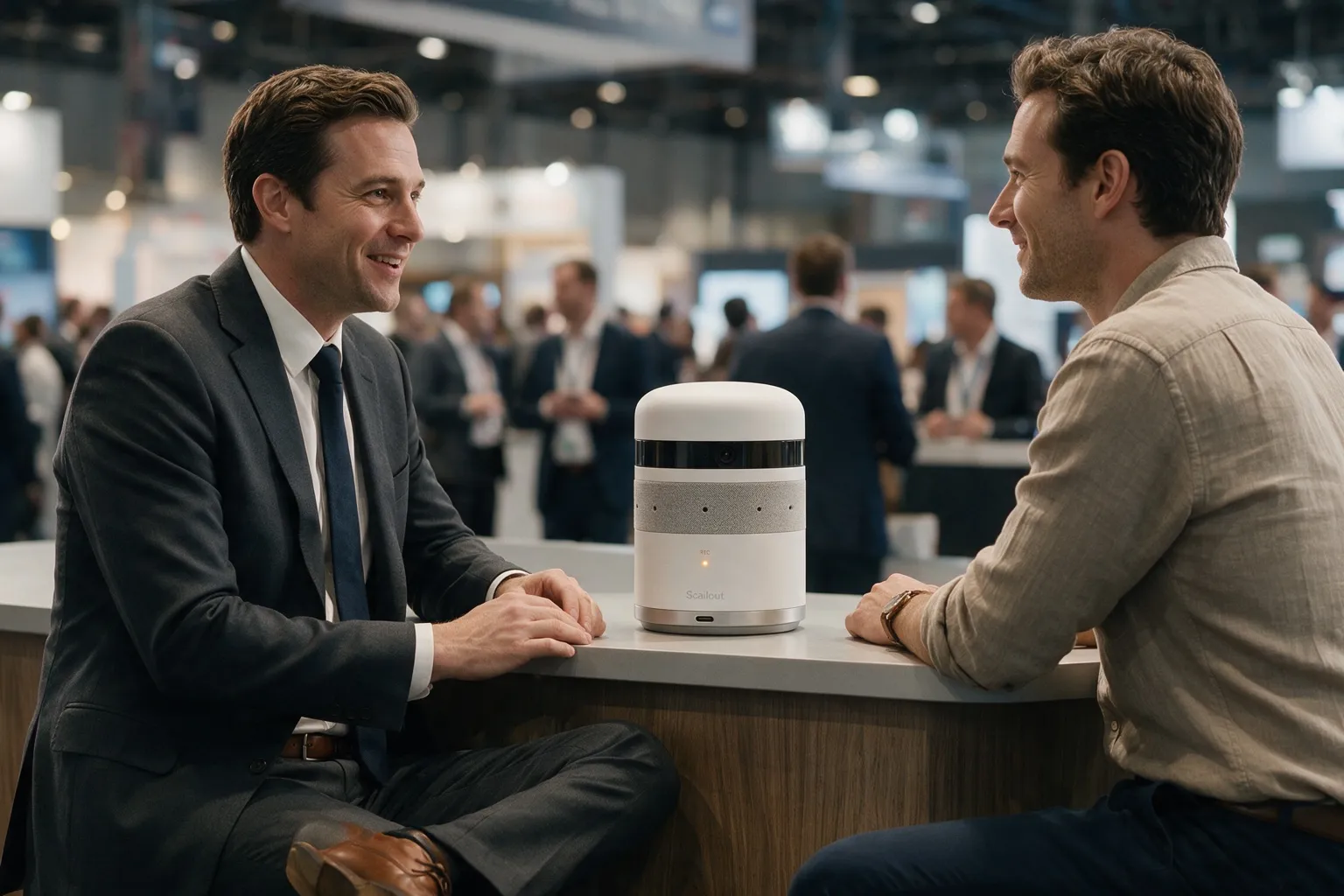
What happens to the conversations nobody recorded
Published numbers on trade-show follow-up are scarce and mostly unsourced, but three named ones survive scrutiny, and they agree on direction. Somewhere between four and eight of every ten conversations an exhibitor pays to have never turn into a follow-up. The gap is not sales discipline. It is the record that was supposed to exist.
| Finding | Named source |
|---|---|
| At least 40 percent of leads generated on the trade show floor go unfulfilled | EXHIBITOR magazine’s Sales Lead Survey, cited by Zuant in December 2018 |
| 79 percent of leads gathered at events never receive a follow-up | Sarah Cox, Managing Director of Jonas Event Technology, speaking at Event Tech Live 2025 |
| 850 attendees said a follow-up had been promised to them; fewer than 150 of those promises were on record | Bob Milam’s exit interviews at the Institute of Food Technologists show, reported in the same Zuant piece |
| Recorded promises went from about 150 to more than 700 in a year once a single person was made responsible for collecting them | The same study, after Milam’s show appointed what he called a Lead Sheriff |
| The widely repeated figure that 80 percent of trade-show leads are never followed up | Untraceable. It is usually attributed to CEIR, whose published research catalog contains no report on lead follow-up at all. We do not use it |
Milam’s is the observation worth sitting with, because it is the only published field measurement of this specific failure. He asked people leaving a show whether an exhibitor had promised to get back to them. Eight hundred and fifty said yes. The exhibitors’ own records held fewer than 150 of those promises. Seven hundred conversations had happened, been valued by both sides, and left no trace on the side that paid for the booth.
Then the correction, which is the informative half. Nothing about the show changed except that one person was given the job of collecting what everyone else had promised. Recorded promises went past 700. The conversations had always been there. What was missing was any mechanism that did not depend on a busy person remembering.
A Lead Sheriff is a person doing what a fixed device does. That is the whole argument of this post, arrived at from the opposite direction, by someone who was not selling hardware.
Move the work to the furniture
So we put the capture in the counter instead of on the person. The station stays where the furniture stays, draws from booth power, and runs for the length of the show without anyone thinking about it. Nothing is worn, nothing is paired, nothing is charged overnight, and no staffer holds a responsibility they can forget in the third hour.
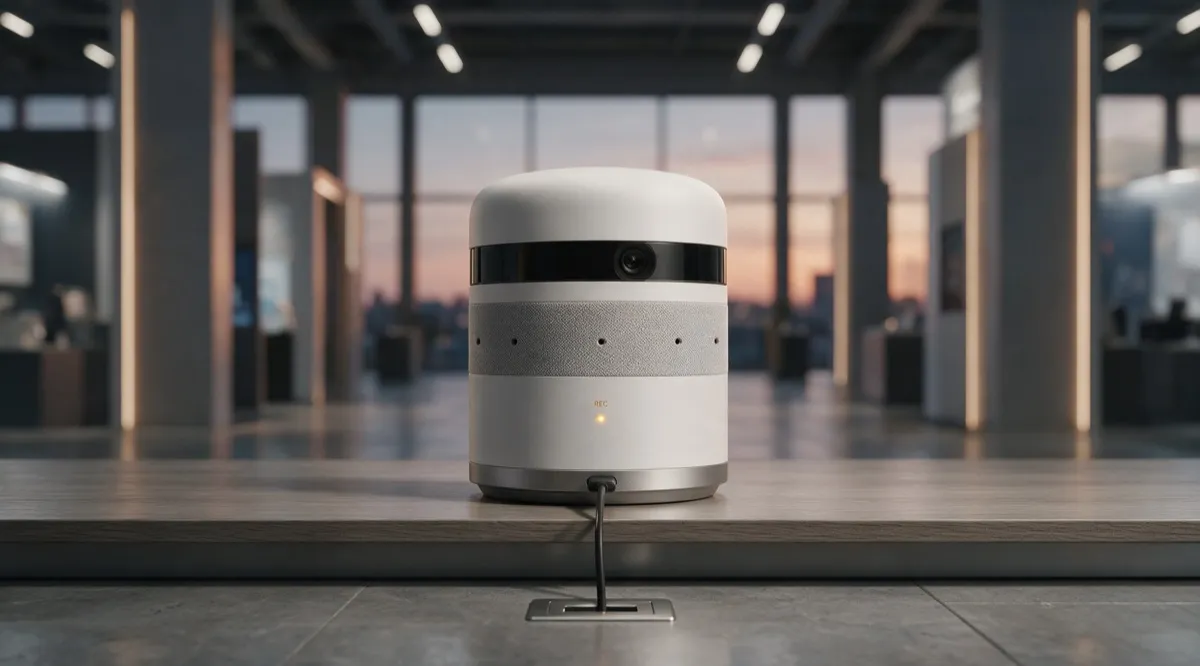
Scailout Station sits on the booth counter and stays plugged into booth power. It has no wearable component, no pairing step, and no app on anyone’s phone. Your staff do not start it, stop it, charge it, or think about it. The install is the whole install: one unit, one cable.
Fixing the position buys something a wearable structurally cannot have: a known geometry. A device clipped to a moving person faces wherever that person happens to face, so the same visitor arrives at a different angle in every conversation. A device bolted to a counter aims at that counter for three days. Direction becomes usable information rather than noise, which is what makes two people talking a metre apart separable at all.
This is the rule we design against, and it is a real constraint rather than a slogan. Any feature that puts an action back on the staffer is a feature we do not ship — no matter how useful it would be in isolation. Once one exists, the reason to choose this product over a wearable is gone.
What that rule forbids
The rule only means something if it costs us features, so here are the ones it costs. Each of these is a reasonable request. Each one would improve some part of the product. All of them are refused for the same reason, which is that they hand a task back to the person we removed the task from.
A button that marks the interesting moment. Every demo audience asks for it, and it would make review faster. It also reintroduces the exact failure Milam counted, because a mark that is forgotten is worse than no mark: it makes the unmarked conversations look uninteresting rather than unrecorded.
A wearable companion for the staffer who steps away from the counter. This one is genuinely useful, and it is the most tempting of the set. It also converts the product back into a thing that is charged, remembered and clipped on, at which point buying it over a wearable recorder makes no sense at all. The conversations outside the booth are a coverage hole we accept rather than close.
A phone app the staffer opens to check status. Status is real and worth showing, so the station shows it on the station. The moment checking it becomes a thing a person does between conversations, we have rebuilt the interruption in software.
A confirmation step before a conversation is stored. It sounds responsible and it would reduce noise in the output. It also means a conversation exists only if somebody remembers to approve it at the end of a ten-hour day, which is the same silent failure wearing a compliance costume.
A per-conversation start and stop for privacy reasons. This is the one with the best argument behind it, and we answer it with the indicator instead, for reasons the next section is about.
Honest by construction
Disclosure has to live in the object for the same reason capture does. If no staffer manages the recording, no staffer can be the one who remembers to mention it either. A rule that survives only when people are rested and unhurried is not a rule. It is a hope with a policy document attached.
Removing the button raises the obvious question: if nobody presses anything, how does the visitor know?
They know because the device shows it. The station carries a visible recording indicator, and there is no setting to turn it off. That is not a regulatory checkbox bolted on late — it is the same principle running the other direction. If the point is that the staffer never has to manage the capture, then the burden of disclosure cannot fall on the staffer either. It has to be built into the object.
Consider what the alternative asks of a person. Announce the recording at the start of every conversation, in the right language, to a visitor who may have walked up mid-sentence, on hour nine, three hundred times. The first fifty will be perfect. Nobody has ever kept a verbal disclosure protocol intact for three days, and a compliance model that depends on it is describing an outcome rather than producing one. Which is why the indicator has no off switch in firmware, and why what the law requires varies by where the show is in ways a staffer should never have to hold in their head.
A device that captures invisibly would be easier to build and impossible to defend. GDPR and two-party consent rules are not obstacles we route around; they describe the behavior we wanted anyway.
What is left over
What the fixed position buys, beyond the removed button, is the part that matters for the pipeline: the station is positioned to hear a specific counter rather than an entire hall, so simultaneous conversations at the same booth can be separated and attributed to the right visitor instead of collapsing into one undifferentiated recording.
There is a second thing, quieter and harder to sell. Fixed geometry sets a hard ceiling on how much the device can resolve at distance, and we have chosen to publish that ceiling rather than engineer around it. A visitor standing far enough away registers as a presence rather than an identity, and that limit is enforced by optics rather than by a promise in a privacy policy. Any buyer is entitled to test that claim, along with eight others, before signing anything. The questions we take to our own manufacturer work equally well pointed at us.
That is the shape of the whole product. Nobody wears anything. Nobody presses anything. The conversation happens the way it would have happened anyway, and the record is still there when the show closes.